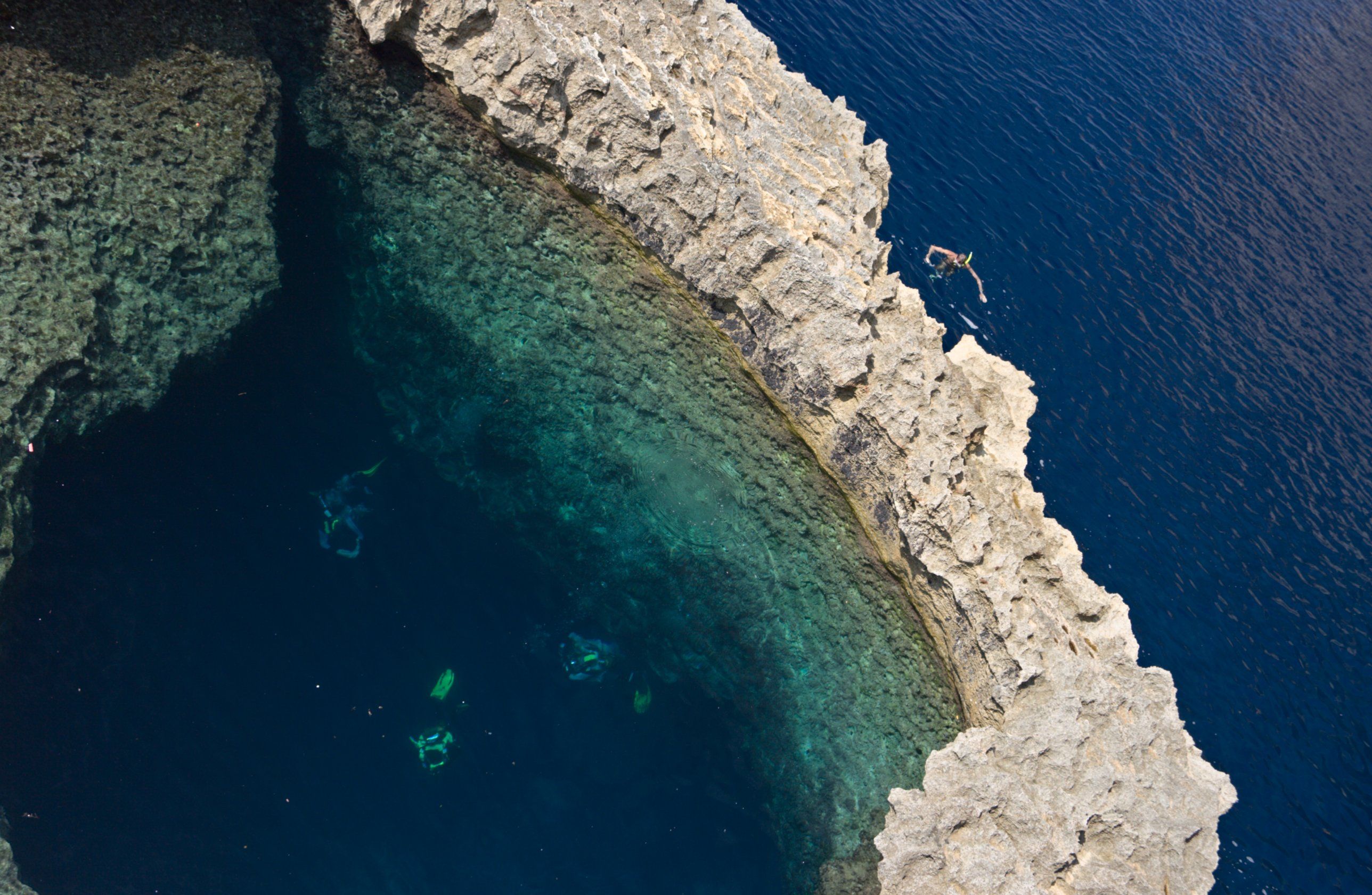
The island's real advantage is that you can park, walk in, and be at thirty metres without ever boarding a boat. That changes what a dive holiday costs and how many dives fit in a week.
12 entries mapped
15°C to mid twenties
Four wrecks
Stock photograph
Why shore diving changes the arithmetic
Most Mediterranean diving is boat diving. You pay for the boat, you go
when the boat goes, and two dives is a day. Gozo is the exception: a
large share of its best water is a short walk from a place you can
leave a car, which means no boat fee, no timetable, and a second dive
in the afternoon if you feel like it.
That is why dive centres cluster here out of all proportion to the size
of the island, and why diving is a genuine part of the local economy
rather than a side activity. It is also why a week in Gozo gets you
more dives than a week almost anywhere else in the region for the same
money.
The trade-off is honest: you carry your kit to the water, some of the
entries are over rock, and a few of the better ones sit at the bottom
of a track you would rather not take a low car down. Each entry page
says which is which.
Where you can get in
Every entry below has its own page with the declared wind exposure,
the live conditions, the state of the access and whether there is
anything there at all. Wind matters more than it sounds: the
direction a site faces decides whether today is a dive or a drive
home.
3 of these have a dive centre on the water:
Dwejra, Xatt l-Aħmar, Xlendi Bay. The rest
you reach with your own kit or with a centre that drives you out.
What is actually down there
The official listings give you fifty-four sites with average and
maximum depths and almost nothing about what is in the water, which
is the first thing anyone putting a regulator in their mouth wants
to know.
The everyday Gozo dive is grouper on the walls, octopus and small
moray in the boulder fields, cuttlefish and seabream over the
sand, and barracuda hanging in the blue off the points. Amberjack
and tuna come through the deeper offshore sites, San Dimitri Point
and Crocodile Rock among them. Seahorses are reported at Coral Cave
and Ħekka Point, which is unusual enough to be worth the dive
on its own.
The shallow bays with sandy bottoms, Ħondoq, Qbajjar and
Daħlet Qorrot, sit on Neptune grass. That is
Posidonia oceanica, a protected seagrass rather than a
weed, it grows a few centimetres a year, and the correct etiquette
is to fin above it rather than through it.
The one everybody asks about
In August 2014 a diver filmed an ocean sunfish, Mola mola,
off Wied il-Mielaħ on the north coast. He described it as a
once in a lifetime experience, and that is the honest framing: these
are enormous, docile, and rare rather than seasonal. A sunfish can
weigh something close to a tonne and is one of the odder things in
the Mediterranean to come face to face with.
Nobody should book a week here expecting one. But Gozo's north coast
drops into open water quickly, which is why the big pelagic animals
turn up at all, and why the sites facing north and west are the ones
where something unexpected tends to happen.
Each coast page lists what has been reported at that site. It is a
record of sightings, not a guarantee of them, and the sea does not
read the website.
The wrecks, and why they are there
Gozo's wrecks are deliberate. Four vessels were scuttled off the south
coast specifically to create dive sites, which is unusual honesty
compared with destinations that market an accident as heritage.
MV Karwela, a 58 metre passenger ferry, sunk in
August 2006 off Xatt l-Aħmar. Sits upright at around 40 metres,
with the staircase on the open deck that everybody photographs.
MV Cominoland, 39 metres, sunk the same month and
lying nearby at a similar depth. The two are often done as one dive.
MV Xlendi, an 80 metre roll-on roll-off ferry sunk in
November 1999, which landed upside down. Penetration is not
recommended and this is not a beginner's wreck.
P31, a Kondor class minesweeper built in the former
East Germany and in Maltese service until 2004, scuttled in 2009 at
about 20 metres off Comino. The shallowest of the four and the
friendliest.
The Azure Window is the other thing divers ask about. It fell into the
sea in March 2017 and the rubble is now a site in its own right. The
Blue Hole and the chimney beside it, which were always the better
dive, are unchanged.
What the water does through the year
Coldest in February and March, around 15 to 16 degrees. Warmest in
August and September, in the mid twenties. It never gets cold enough
to close the season, so centres run almost all year with a short lull
in deep winter when the weather rather than the temperature is the
problem.
Spring and autumn are the better bet. The water is still warm in
October, the visibility is good, and you are not sharing Dwejra with
four boatloads of people. Winter diving is genuinely available and
genuinely quiet, with the caveat that a northerly will shut the whole
north coast and send you to the south.
That last point is the practical one and the reason each site page
carries its wind exposure: when Gozo is blown out on one side it is
usually diveable on the other, and knowing which way round saves the
day.
The rules that actually apply
Recreational diving in Malta is regulated, and more tightly than most
visitors expect. The short version:
Only dive centres licensed by the Malta Tourism Authority may sell
diving services. Ask; a licensed centre will not mind.
You may dive independently if your certification qualifies you to 30
metres. Below that, a licensed instructor goes with you.
There is no statutory minimum age. The training agency sets it, and
every diver under 18 needs written consent from a parent or
guardian.
A medical questionnaire is required. Certain declared conditions
need a fitness certificate signed by a doctor who specialises in
diving or hyperbaric medicine.
Rebreathers, nitrox and trimix are all permitted, subject to the
training and experience you can show.
Spearfishing on scuba is banned outright, as is any spearfishing
between dusk and dawn, and all fishing inside Marine Conservation
Areas.
There is a hyperbaric chamber at Gozo General Hospital, which is part
of why the island works as a technical diving base rather than only a
recreational one. In an emergency the number is 112.
Regulations change and this is a summary, not advice. Check the
current position with your centre before you plan anything that sits
near a limit.
Yes, and it is the island’s main distinction as a dive destination. An unusual proportion of Gozo’s sites are reachable on foot from a parking spot, which removes the boat fee and the fixed schedule and makes two dives in a morning practical.
What is the water temperature in Gozo through the year?
Coldest in February and March at around 15 to 16 degrees Celsius, warmest in August and September in the mid twenties. It does not fall low enough to stop diving, so centres run most of the year with a short winter lull.
Do you need a licence or a guide to dive independently in Gozo?
Under Malta’s recreational diving regulations you may dive independently if your certification qualifies you to 30 metres. Below that level a licensed instructor must accompany you, and only dive centres licensed by the Malta Tourism Authority may sell diving services. Divers under 18 need written consent from a parent or guardian.
What happened to the Azure Window, and can you still dive it?
It collapsed into the sea in March 2017. The rubble is now itself a dive site off Dwejra, and the adjacent Blue Hole and chimney, which were always the better dive, are unaffected.
Can you see ocean sunfish or other large animals off Gozo?
Occasionally, and it is a genuine event rather than a seasonal fixture. An ocean sunfish, Mola mola, was filmed off Wied il-Mielaħ in August 2014 by a diver who called it a once in a lifetime experience. Barracuda, amberjack and tuna are far more regular on the deeper offshore sites, and grouper, octopus and moray are everyday.
Where is the nearest decompression chamber?
There is a hyperbaric chamber at Gozo General Hospital, which is one reason the island is comfortable as a technical diving base. In an emergency the number is 112.
Is spearfishing allowed?
Not on scuba, and not at all between dusk and dawn. All fishing is banned inside Marine Conservation Areas. Minimum sizes and protected species rules apply to recreational divers exactly as they do to anyone else.
Cookies, briefly
This site needs nothing from you to work. Analytics tells us which
pages are worth writing more of, and a booking link needs to know it
came from here in order to pay for the writing. You choose which of
those is fine.
What each one does.